
Our leader Renee McNiel recently was going through our archives and came across an article that she wrote in 2008 for International Facilities Management Association Houston Chapter newsletter. After rereading this piece, we realized how we were way ahead of the curve when it came to green moves! As it turns out, this information on environmental corporate moves is even more relevant today. So this month, we’re sharing a bit of a throwback, knowing our clients will find this quite a gem!
A corporate move is a challenging event for facilities managers in that it typically happens at the tail end of a major construction project handled by that same facilities manager. While more and more corporations are considering or opting for sustainable environments, the same choices hold true in the world of relocation. There are a number of ways to green your move such as cleaning out prior to the move, recycling electronic equipment, using environmentally conscience building materials, utilizing crates and purchasing carbon credits.
There are pieces of the relocation puzzle that will aid in minimizing the amount of paper storage and thereby save on your square feet and will also save on your need for shelving to accommodate that paper. One method of saving space and saving dollars is by implementing a trash day prior to your move. Incorporate into that day, the information needed to effectively throw away what needs to be trashed versus items that legally must be kept with regard to records, logs, books, etc. Including your records retention information with trash day information will make employees more comfortable about actually throwing away unnecessary documents, etc. For a small investment in lunch, shredding containers, trash bins and a cleaning crew, your savings in both your footprint and your move can easily be realized.
Another issue for the sustainable conscientious is what to do with electronics that are no longer of use. There are a number of companies that offer services to recycle your computers and cell phones. Further, it is important to make sure that we are not throwing computers and cell phones into landfills. Here is an excerpt from the US Geological Survey website: “The metals contained in PC’s commonly include aluminum, antimony, arsenic, barium, beryllium, cadmium, chromium, cobalt, copper, gallium, gold, iron, lead, manganese, mercury, palladium, platinum, selenium, silver, and zinc. Eight of these metals (shown in bolded type) are listed as hazardous by the Resource Conservation and Recovery Act (RCRA), one of the federal laws that control the disposition of waste in the United States. This law prohibits companies from incinerating some types of electronic scrap or disposing of it into municipal landfills.”
On a recent project, CMCI had a client who needed to get rid of a number of computers and a few servers. We called United Way to inquire about what they might do. Here in Houston, the United Way has a recycle program called Gifts in Kind wherein IBM technicians wipe the computers clean and United Way provides the computers back out to non-profit organizations.
Unless you have had a vendor provide you information on sustainable products in the relocation industry, it is not likely that you would have considered them or have even known they were out there. When it is time to consider relocation vendors, it is also time to consider the products they may or may not bring. If you are affiliated with a corporation who moves regularly (restacks), it is a good idea to consider purchasing or renting building protection materials. When considering building protection, you may want to include Coroflex® – a plastic material that is typically 4’ X 8’ and can be reused. Coroflex is used to protect your walls. It is large to store but really provides the protection of your walls where you need. There are also quilted pads for doors and elevators that can be purchased or specified in your bid requirements.
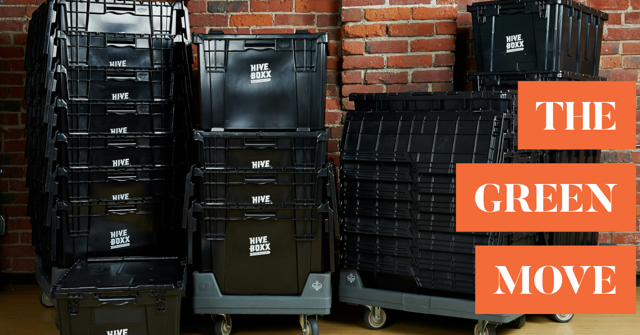
In addition to reusable building materials, there are also products for packing that are reusable—a moving crate. According to Rentacrate, a plastic moving crate saves our resources because they are reusable for a minimum of 10 years and there is no logging of trees in making crates. Crates can be purchased for those continually restacking, be specified in your moving bid requirements or can be rented through a crate rental company. The return on investment on utilizing crates is in labor savings on your move and in knowing that you have not contributed to the further logging of trees to create moving boxes. Additionally, you are saving on the number of truckloads. With a box move, you would move 338 cubic feet per truck whereas utilizing crates, you could move 600 cubic feet per truck. Crates come with dollies and are packed by the end user with the dolly underneath. When the moving crew arrives, there is no loading/unloading of boxes on to dollies, it is already done—saving labor and time—and thereby, your money. A crate is twice the size of a typical moving box (boxes are 1.5 cubic feet and crates are 3.0 cubic feet), which will assist in ensuring that the end user unpack the materials since crates take up more room in their offices.
Another possibility is to purchase carbon credits to offset the CO2 emissions of the moving trucks. Wikipedia defines carbon credits as follows:
“Carbon credits are a key component of national and international emissions trading schemes. They provide a way to reduce greenhouse effect emissions on an industrial scale by capping total annual emissions and letting the market assign a monetary value to any shortfall through trading. Credits can be exchanged between businesses or bought and sold in international markets at the prevailing market price. Credits can be used to finance carbon reduction schemes between trading partners and around the world.
There are also many companies that sell carbon credits to commercial and individual customers who are interested in lowering their carbon footprint on a voluntary basis. These carbon offsetters purchase the credits from an investment fund or a carbon development company that has aggregated the credits from individual projects. The quality of the credits is based in part on the validation process and sophistication of the fund or development company that acted as the sponsor to the carbon project. This is reflected in their price; voluntary units typically have less value than the units sold through the rigorously-validated Clean Development Mechanism.”
Carbon credits can be purchased at a number of companies. Back in 2008, Terra Pass said on a 25,000 square foot move, the cost of the carbon credit off-set would be about $11. This cost is to off-set one metric ton of CO2 emissions created by the moving company trucks.
At the 2007 IFMA World Workplace Conference, the topic most discussed was sustainability. The relocation industry has changed in the last two decades and continues to strive to ensure it meets the needs of its most important client – the facilities manager. By including the items discussed here, you can save the earth’s resources, assist in your sustainability program and goals, and save your corporation money.
For help with your next corporate move, contact CMCI.
Originally featured in the International Facilities Management Association Houston Chapter newsletter.